Disclosure: Money Zoomer may earn a commission if you sign up for a product through links on this page, at no extra cost to you. Our opinions are our own, and a commission never changes what we write. See our Editorial Guidelines for how we review products.
Financial Disclaimer: This article is for general educational purposes only. It is not personalized financial, tax, legal, or investment advice, and Money Zoomer is not a licensed financial advisor. Investing involves risk, including the possible loss of principal. Consider speaking with a qualified professional before making financial decisions.
Index funds and ETFs are two of the most popular ways to start investing, and they are often presented as rivals. In reality they are not opposites at all, which is why so many beginners get confused. Many ETFs are index funds, and many index funds are not ETFs.
This guide explains what each one is, how they differ in practice, and a simple way to decide where to start, without pushing any particular product.
What Is an Index Fund?
An index fund is a fund that aims to match the performance of a market index, such as the S&P 500, rather than trying to beat it. Instead of paying a manager to pick winners, the fund simply holds the securities in the index. Because there is little active decision-making, index funds typically charge lower fees than actively managed funds.
An index fund can be structured in two ways: as a traditional mutual fund or as an exchange-traded fund (ETF). That is the key to the whole comparison.
What Is an ETF?
An ETF is a fund that trades on a stock exchange throughout the day, just like an individual stock. Some ETFs track an index (an index ETF), while others are actively managed or follow a narrow theme. So when people compare index funds and ETFs, they usually mean index mutual funds versus index ETFs: the same investing idea in two different wrappers.
Index Mutual Funds vs. Index ETFs
| Index mutual fund | Index ETF | |
| How it trades | Priced once a day, after the market closes | Trades all day at market prices |
| Minimum to start | Some funds require a minimum, though many are low or none | Often the price of one share, and many brokers allow fractional shares |
| Automatic investing | Typically easy to schedule fixed-dollar purchases | Increasingly available, depending on your broker |
| Costs | Expense ratio; some may have other fees | Expense ratio plus a small bid-ask spread when trading |
| Tax efficiency (taxable accounts) | Can distribute capital gains to holders | Often more tax-efficient because of how shares are created and redeemed |
In a retirement account such as a 401(k) or IRA, the tax difference mostly disappears because gains are not taxed year to year. In that setting, the choice often comes down to which options your plan or broker offers and how convenient they are.
Why Fees Matter More Than the Wrapper
The most important number on either type of fund is its expense ratio, the annual fee expressed as a percentage of your investment. A small difference compounds into a big one over decades.
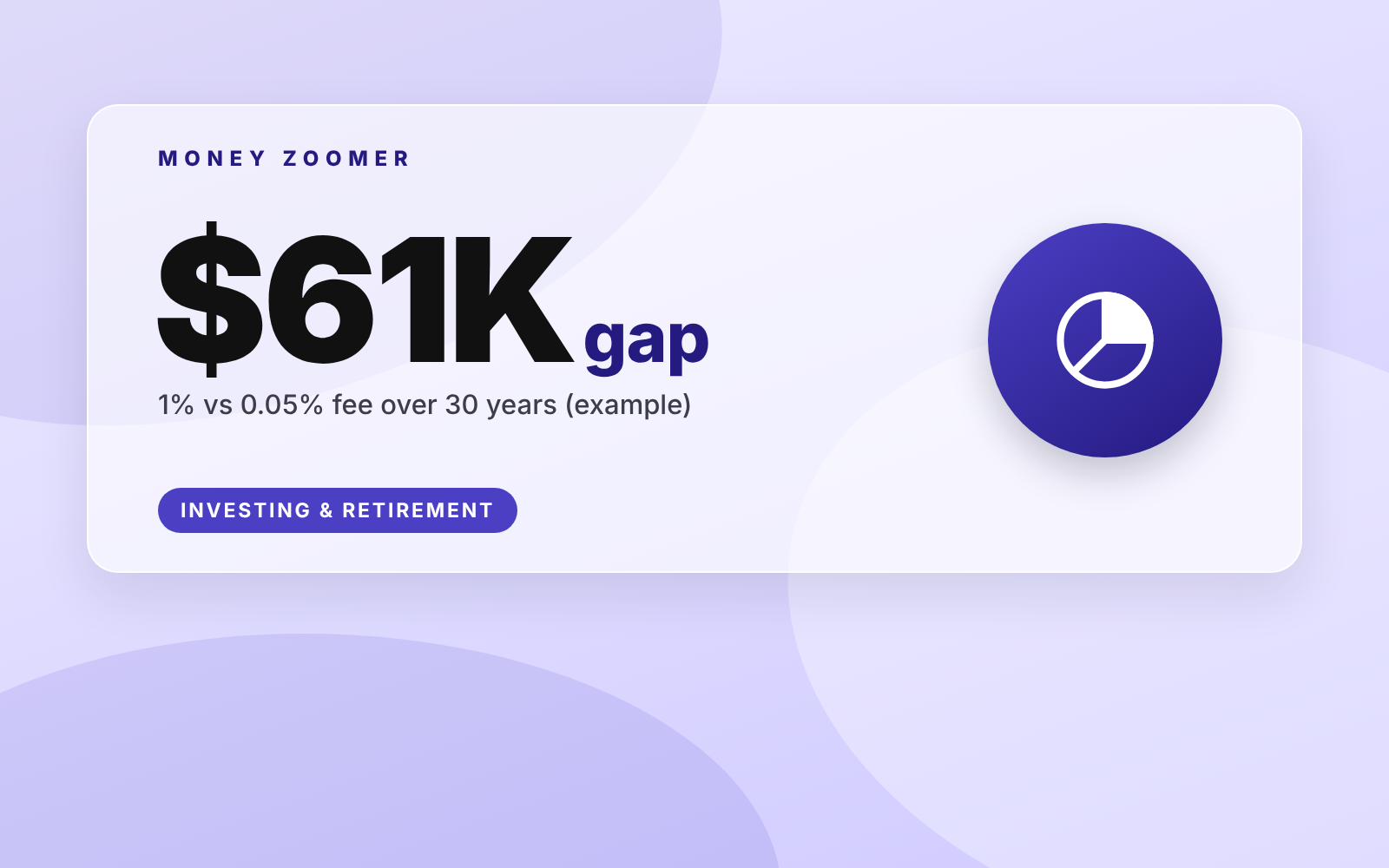
Here is an illustration. Imagine investing $300 a month for 30 years ($108,000 contributed in total) and earning a hypothetical 7% a year before fees. This is not a forecast, only a way to see the effect of costs:
| Annual fee | Value after 30 years | Difference |
| 0.05% | About $362,000 | – |
| 1.00% | About $301,000 | About $61,000 less |
The two funds earned the same market return, but the higher fee quietly consumed roughly $61,000. That is why many beginners focus on broad, low-cost funds, whether in mutual fund or ETF form.
How to Choose: A Simple Checklist
- Start with the account. Decide whether you are investing through an employer plan, an IRA, or a regular brokerage account. What is available depends on the account.
- Choose a broad index. A fund that tracks a wide slice of the market spreads your money across many companies instead of a few.
- Compare expense ratios. Look for the lowest cost among funds that track the same or a similar index.
- Check minimums and trading options. If you plan to invest a fixed amount every month, confirm your broker supports it for the fund you pick.
- Consider taxes. In a taxable account, the structure can matter more; in a retirement account, it matters less.
- Automate and stay consistent. Regular contributions over many years usually matter more than the exact product.
Know Your Contribution Limits for 2026
Where you invest also shapes how much you can put in. According to the IRS limits for 2026 as reported by InvestmentNews:
- 401(k): employee contribution limit of $24,500, with an extra $8,000 catch-up for people aged 50 and over.
- IRA (traditional or Roth): $7,500, with an extra $1,100 catch-up for people aged 50 and over.
- Roth IRA income phase-out: $153,000 to $168,000 for single filers and $242,000 to $252,000 for married couples filing jointly.
If your employer offers a matching contribution in your 401(k), contributing enough to receive the full match is a common first step, since a match is effectively part of your compensation. Always confirm current limits and your own eligibility with the IRS or a tax professional.
Are Index Funds and ETFs Safe?
They are diversified, but they are not risk-free. An index fund that tracks the stock market will fall when the market falls, and in a severe downturn it can lose a large share of its value before recovering. Neither type of fund guarantees a return, and past performance does not predict future results. Investing money you may need within a few years is generally riskier than investing money you will not touch for a decade or more, which is another reason to build an emergency fund first.
Frequently Asked Questions
Do I need to own both an index fund and an ETF?
No. Because they can hold the same underlying investments, owning both of the same index adds little. One broad, low-cost fund is a reasonable starting point for many people.
Which is better for a total beginner?
Whichever is easier for you to buy, automate, and hold. For many beginners, that is whichever option their account or employer plan offers at the lowest cost.
Can I lose money in an index fund?
Yes. The value rises and falls with the market. The goal of broad diversification is to reduce the risk of any single company failing, not to eliminate market risk.
Key Takeaways
- An index fund is a strategy (tracking an index); an ETF is a structure (trading on an exchange). They can be the same thing.
- Low fees are one of the few things you can control, and they compound over time.
- In retirement accounts the tax difference is small; in taxable accounts ETFs are often more tax-efficient.
- Know your annual contribution limits, and invest only money you will not need soon.
- Consistency beats picking the perfect product.
Sources
- InvestmentNews, IRS reveals new 401(k), IRA contribution limits for 2026.
- gov (U.S. SEC), Mutual Funds and Exchange-Traded Funds (ETFs).
- Fee illustration calculated by Money Zoomer using a constant hypothetical 7% annual return before fees, monthly contributions of $300, and monthly compounding. It is not a forecast.