Disclosure: Money Zoomer may earn a commission if you sign up for a product through links on this page, at no extra cost to you. Our opinions are our own, and a commission never changes what we write. See our Editorial Guidelines for how we review products.
Financial Disclaimer: This article is for general educational purposes only. It is not personalized financial, tax, legal, or investment advice, and Money Zoomer is not a licensed financial advisor. Your situation is unique, so consider speaking with a qualified professional before making financial decisions.
A flat tire, a surprise medical bill, a sudden layoff: none of them wait until your budget has room for them. An emergency fund is the cash cushion that turns a financial crisis into an inconvenience, and it is the foundation almost every other money goal sits on.
This guide walks you through how much to save, where to keep the money, and a practical step-by-step plan for building it, even if you are starting from zero today.
What an Emergency Fund Is (and What It Is Not)
An emergency fund is money set aside only for unexpected, necessary expenses: the kind you cannot postpone and did not plan for. It is not a vacation fund, a holiday fund, or a place to park money for a sale you spotted. Keeping that line clear is what makes the fund work, because a cushion you dip into for wants is a cushion that is empty when a real emergency arrives.
It is also not an investment. The job of an emergency fund is not to grow; it is to be there, in full, the day you need it. That is why where you keep it matters just as much as how much you save.
How Much Should You Save?
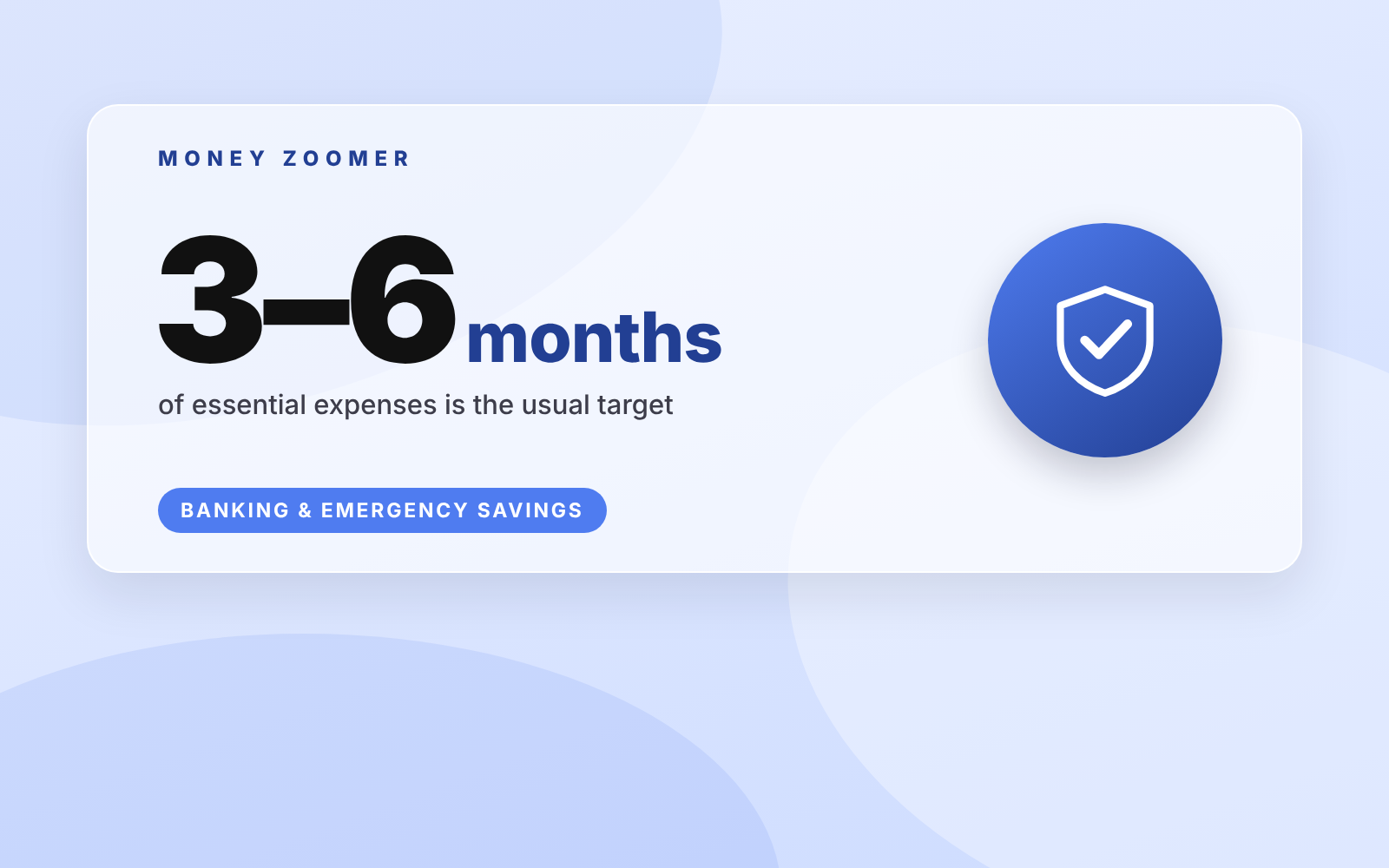
The most common rule of thumb is to hold three to six months of essential expenses. Essentials are the bills you must pay to keep your life running: housing, utilities, groceries, transport, insurance, minimum debt payments, and phone or internet. Dining out, subscriptions, and shopping do not count, because you would cut them first in a crisis.
The right target depends on how stable your situation is. These are widely used guidelines, not guarantees:
| Your situation | Common target | Why |
| Stable job, no dependents, second household income | About 3 months | Lower risk of a long gap in income |
| Single income, or people who depend on you | 4 to 6 months | One lost paycheck affects the whole household |
| Self-employed, commission-based, or irregular income | 6 to 12 months | Income can dry up with little warning |
A Quick Worked Example
Suppose your essential monthly costs look like this: rent $1,200, utilities $150, groceries $400, transport $250, insurance $200, minimum debt payments $200, and phone and internet $100. That adds up to $2,500 a month. Three months of essentials is $7,500 and six months is $15,000.
That number can feel enormous at first, so do not start there. Start with a smaller milestone and build up.
Step-by-Step: Building Your Emergency Fund
- Calculate your essential monthly expenses. Use your last two or three bank statements and total only the must-pay bills, as in the example above.
- Set a starter goal of $1,000 (or one month of essentials). This first milestone handles the most common surprises, such as a car repair or an urgent dental visit, and it gives you momentum.
- Open a separate account. Keeping the fund apart from your everyday checking account makes it harder to spend by accident and easier to track.
- Automate the transfer. Set a recurring transfer for the day after payday. Saving what is left over rarely works; saving first does.
- Find the money. Review recurring charges and cancel what you no longer use, negotiate your phone or internet bill, and temporarily pause optional spending until the starter fund is in place.
- Add windfalls. Tax refunds, bonuses, and gifts are ideal for a fast boost. Even sending half of each windfall to the fund makes a visible difference.
- Move toward the full target. At $150 a month, a $7,500 fund takes roughly four years. At $300 a month it takes about two. Increase your transfer whenever your income rises.
Where to Keep Your Emergency Fund
You want three things: safety, easy access, and a little interest. For most people that points to a high-yield savings account or a money market account at a bank or credit union.
- Safety: In the United States, deposits at FDIC-insured banks are protected up to $250,000 per depositor, per insured bank, for each ownership category. Credit unions offer similar protection through the NCUA. Always confirm that the institution is insured.
- Access: You should be able to move the money to your checking account within a day or two, without penalties.
- Interest: Savings rates change over time and vary widely between institutions, so compare current rates before opening an account rather than relying on a number from an article.
Avoid keeping your emergency fund in stocks or other investments. Markets can fall at the very moment you need the money, for example during a recession when layoffs are also more likely.
What Counts as an Emergency?
| Yes, use the fund | No, use your regular budget |
| Job loss or a sudden drop in income | A sale or limited-time deal |
| Urgent medical or dental costs | Planned vacations or gifts |
| Essential car or home repairs | Annual bills you could have predicted (use a sinking fund) |
| Emergency travel for a family crisis | Upgrading a phone that still works |
A simple test: is it unexpected, necessary, and urgent? If the answer to all three is yes, it is an emergency.
Emergency Fund or Pay Off Debt First?
This is one of the most common questions, and the honest answer is that you usually need both. According to the Federal Reserve’s G.19 consumer credit release, the average interest rate on credit card accounts in the third quarter of 2026 was 21.19% across all accounts, and 22.36% on accounts that were assessed interest. Carrying a balance at those rates is expensive.
But without any cash cushion, an unexpected bill simply goes back on the card, and the debt grows. A widely used approach is to build a small starter fund first (such as $1,000), then put extra money toward high-interest debt, and then return to building the full three-to-six-month fund. If you want a plan for the debt step, see our guide to the debt snowball and debt avalanche methods.
Common Mistakes to Avoid
- Waiting until you can save a lot. Small, consistent transfers beat a perfect plan that never starts.
- Mixing the fund with everyday money. If you can see it next to your spending account, you will be tempted to use it.
- Never replenishing it. After you use the fund, rebuilding it becomes your top savings priority.
- Chasing the highest rate. A rate difference of a fraction of a percent matters far less than actually saving consistently.
- Counting credit as savings. A credit card or credit line is borrowing, not a cushion. It has to be repaid, usually with interest.
Frequently Asked Questions
Is $1,000 enough for an emergency fund?
It is a good first milestone, but it will not cover a job loss. Treat it as a starting point on the way to three to six months of essential expenses.
Should I keep my emergency fund in cash at home?
A small amount of cash can be handy, but most of your fund is safer and more useful in an insured account, where it is protected from theft, loss, and fire, and can earn interest.
What if I have irregular income?
Base your target on your essential expenses, aim for the higher end of the range, and consider saving a fixed percentage of every payment you receive rather than a fixed dollar amount.
Key Takeaways
- Aim for three to six months of essential expenses, adjusting for how stable your income is.
- Start with a $1,000 starter goal, then build from there.
- Keep the money in an insured, easily accessible savings account, separate from daily spending.
- Automate your transfers and add windfalls whenever you can.
- Define what counts as an emergency before you need the money, and replenish the fund after using it.
Sources
- Federal Reserve, 19 Consumer Credit release, interest rate on credit card plans, Q3 2026.
- FDIC, Deposit Insurance: coverage limits and ownership categories.