Disclosure: Money Zoomer may earn a commission if you sign up for a product through links on this page, at no extra cost to you. Our opinions are our own, and a commission never changes what we write. See our Editorial Guidelines for how we review products.
Financial Disclaimer: This article is for general educational purposes only. It is not personalized financial, tax, legal, or investment advice, and Money Zoomer is not a licensed financial advisor. Your situation is unique, so consider speaking with a qualified professional before making financial decisions.
If you are juggling several debts, the hardest question is often not whether to pay them off, but which one to pay first. Two popular strategies give opposite answers: the debt snowball starts with your smallest balance, while the debt avalanche starts with your highest interest rate.
In this guide we compare both methods side by side, run the same set of debts through each, and look at what research says about which one people actually stick with.
How the Debt Snowball Works
With the snowball method, you list your debts from the smallest balance to the largest, ignoring interest rates. You pay the minimum on every debt, then throw every spare dollar at the smallest one. When it is gone, you roll that payment (the minimum plus the extra) onto the next smallest debt, and so on. The payment grows like a snowball rolling downhill.
The appeal is psychological. Closing out accounts quickly gives you visible wins, which can keep you motivated through a long payoff journey.
How the Debt Avalanche Works
With the avalanche method, you list your debts from the highest interest rate (APR) to the lowest, regardless of balance. You pay the minimum on everything and direct the extra money to the highest-rate debt first. When it is paid off, you move to the next highest rate.
The appeal is mathematical. Because you attack the most expensive debt first, you pay less total interest than with any other order, assuming you keep making the same total payment each month.
A Side-by-Side Example
Imagine you owe the following, and you can put $500 a month toward debt in total (about $245 more than the minimums):
| Debt | Balance | APR | Minimum | Snowball order |
| Personal loan | $1,500 | 6% | $50 | 1st (smallest) |
| Credit card B | $3,000 | 19% | $80 | 2nd |
| Credit card A | $5,000 | 27% | $125 | 3rd (largest) |
The avalanche order is the reverse: card A (27%) first, then card B (19%), then the loan (6%). Running both strategies month by month gives these results:
| Snowball | Avalanche | |
| First debt fully paid off | Month 6 | Month 17 |
| Debt-free | Month 25 | Month 23 |
| Total interest paid | About $2,608 | About $1,977 |
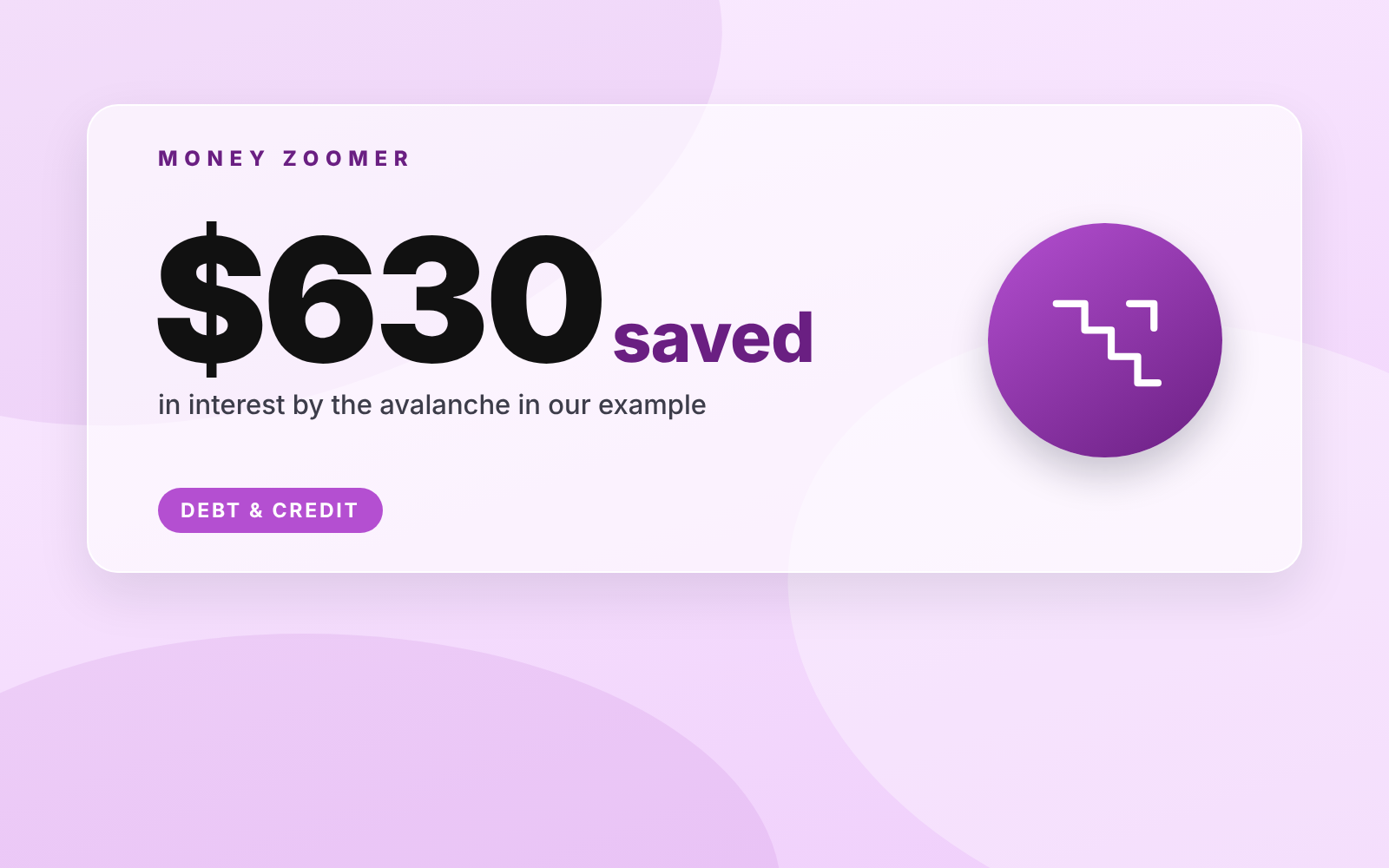
In this example the avalanche saves roughly $630 in interest and finishes two months sooner. The snowball, however, gives you your first win in month six rather than month seventeen. These figures assume monthly interest at one-twelfth of the APR, fixed payments, and no new charges, so your real numbers will differ, but the pattern is typical.
For context, the Federal Reserve reported that the average interest rate on credit card accounts was 21.19% across all accounts in the third quarter of 2026, and 22.36% on accounts that were assessed interest. When rates are that high, the order in which you pay can matter.
What Does the Research Say?
Researchers have studied how people actually behave when paying down debt, and the findings are more nuanced than the math alone:
- A 2011 study in the Journal of Marketing Research by Amar, Ariely, Ayal, Cryder and Rick found that many people tend to pay small debts first, a pattern the authors call “debt account aversion,” driven by a wish to reduce the number of debts and feel progress. When participants could see the interest cost, they tended to make more mathematically optimal choices.
- A 2016 paper in the Journal of Consumer Research by Kettle, Trudel, Blanchard and Häubl examined how concentrating repayments affects motivation. It suggested that people feel more motivated when their payments eliminate a larger share of an individual balance, which helps explain why focusing on small debts can feel so powerful.
The takeaway is not that one method is always right. The best strategy is the one you will follow until the debt is gone. A mathematically perfect plan you abandon after three months saves you nothing.
Snowball vs. Avalanche at a Glance
| Debt snowball | Debt avalanche | |
| Order | Smallest balance first | Highest APR first |
| Biggest strength | Quick wins and motivation | Lowest total interest |
| Biggest weakness | Usually costs more interest | First payoff can take a long time |
| Best for | People who need momentum | People motivated by saving money |
Which Method Should You Choose?
- Choose the avalanche if your highest-rate debt is also large, if the rate gaps between your debts are wide, and if you are disciplined enough to stay the course without early wins.
- Choose the snowball if you have tried and failed to get out of debt before, if you have many small balances, or if you need visible progress to stay motivated.
- Consider a hybrid. Some people pay off one or two tiny balances first for a quick win, then switch to the avalanche order for the rest.
If your debts all have similar interest rates, the difference in cost between the two methods will be small, so pick the one that feels better.
Steps to Start This Month
- List every debt with its balance, APR, and minimum payment. Your statements or online accounts will show all three.
- Decide your total monthly debt payment. Look at your budget and find the largest amount you can commit to consistently.
- Pick a method and rank your debts accordingly.
- Pay the minimum on everything to avoid late fees and credit damage, then send the extra to your first target.
- Automate the payments so the plan runs without relying on willpower.
- Roll payments forward each time a debt is cleared, and stop adding new charges to the cards you are paying off.
Other Options Worth Knowing About
A balance transfer card can move high-interest card debt to a lower introductory rate, but transfers usually carry a fee (often around 3% to 5% of the amount) and the promotional period eventually ends. A debt consolidation loan can combine several debts into one payment, which may lower your rate if your credit is good, but it only helps if you stop running up the old cards. Compare the total cost, including fees, before you commit. If your debt feels unmanageable, a nonprofit credit counseling agency can review your options for free or at low cost.
Frequently Asked Questions
Does the snowball method ever beat the avalanche?
On pure interest cost, no, assuming equal total payments. It can win in practice if it keeps you from giving up.
Should I build an emergency fund first?
Most people benefit from a small starter fund first so that a surprise expense does not go straight back on a credit card. See our guide to building an emergency fund.
Do I pay off the debt with the highest balance or the highest interest first?
That depends on the method. The snowball targets the lowest balance, the avalanche targets the highest interest rate.
Key Takeaways
- The snowball targets the smallest balance first; the avalanche targets the highest interest rate first.
- The avalanche usually saves more interest; the snowball often delivers faster early wins.
- In our example, the avalanche saved about $630 and finished two months sooner, but the first payoff took 11 months longer.
- The best method is the one you will stick with until the last balance is gone.
Sources
- Federal Reserve, 19 Consumer Credit release, interest rate on credit card plans, Q3 2026.
- Amar, M., Ariely, D., Ayal, S., Cryder, C. E., and Rick, S. I. (2011). Winning the Battle but Losing the War: The Psychology of Debt Management. Journal of Marketing Research.
- Kettle, K. L., Trudel, R., Blanchard, S. J., and Häubl, G. (2016). Repayment Concentration and Consumer Motivation to Get Out of Debt. Journal of Consumer Research, 43(3), 460-477. Listing on RePEc